TACTICS · DOUBLES
Badminton doubles rotation you can actually see
Doubles rotation becomes much easier when you stop memorising paths and ask one question: is our side attacking downward, or defending against a downward shot?
Reviewed against the BWF Laws of Badminton · Updated 31 August 2026Start with two team shapes
- 01Attacking downward: one player covers the front and the other covers the rear.
- 02Defending a smash: stand roughly side by side so each player protects half the width.
- 03When the shot changes, move together—do not wait for your partner to fix the gap.
INTERACTIVE TEAM SHAPES
Switch between attack, defence and transition.
Four athletes show the spaces each pair is trying to cover. Floor arrows explain the change of shape.
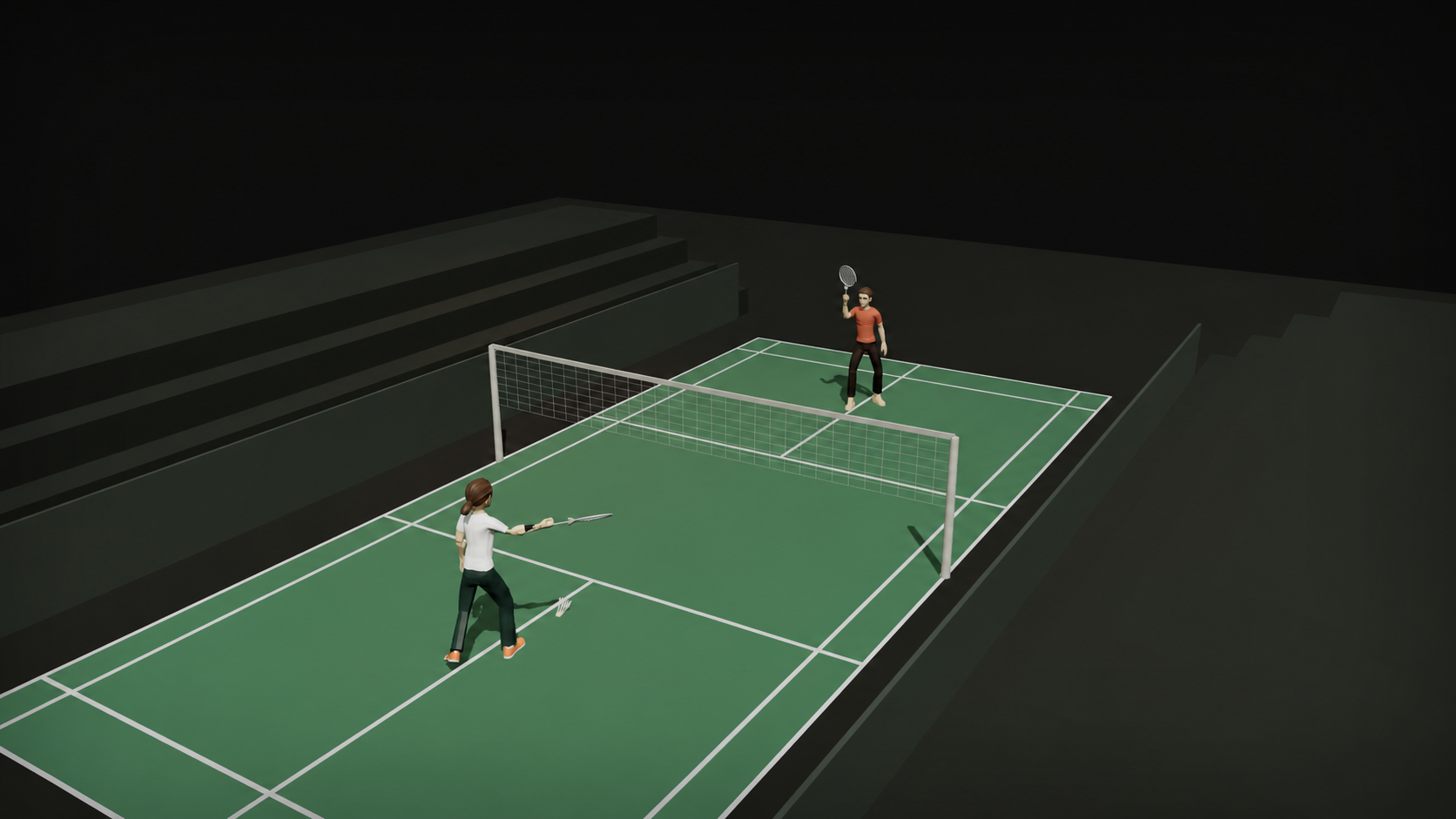
Loading doubles positions…
FRONT + BACKThe rear player attacks downward. The front player looks for a loose block or drive near the net.
Drag to rotate · Double-click to reset01 / ATTACK
Front and back cover different jobs
When your side can hit downward, the rear player covers clears and continues the attack. The front player watches for short blocks, weak drives and net replies.
The front player should not stand on the tape. Leave enough space to react and avoid blocking the rear player’s swing.
02 / DEFENCE
Side by side protects the width
When the opponent is smashing, standing front and back leaves one defender with too much width. Side-by-side positions give each player a clearer half.
The exact split depends on where the attacker hits from. Move as a pair and avoid leaving a large channel between you.
03 / TRANSITION
The shot tells both players to move
If your side lifts, expect an attack and form side-by-side defence. If your side forces a weak lift, one player can take the rear attack while the partner moves forward.
Call “mine,” “front” or “back” when the situation is unclear. Good rotation is shared timing, not two solo runs.